Nos Campus

    • Campus Mutanga
    • Campus Rohero
    • Campus Kiriri
    • Campus Kamenge
    • Campus Nyamugerera
    • Campus Buhumuza
    • Campus Zege

université du Bururndi

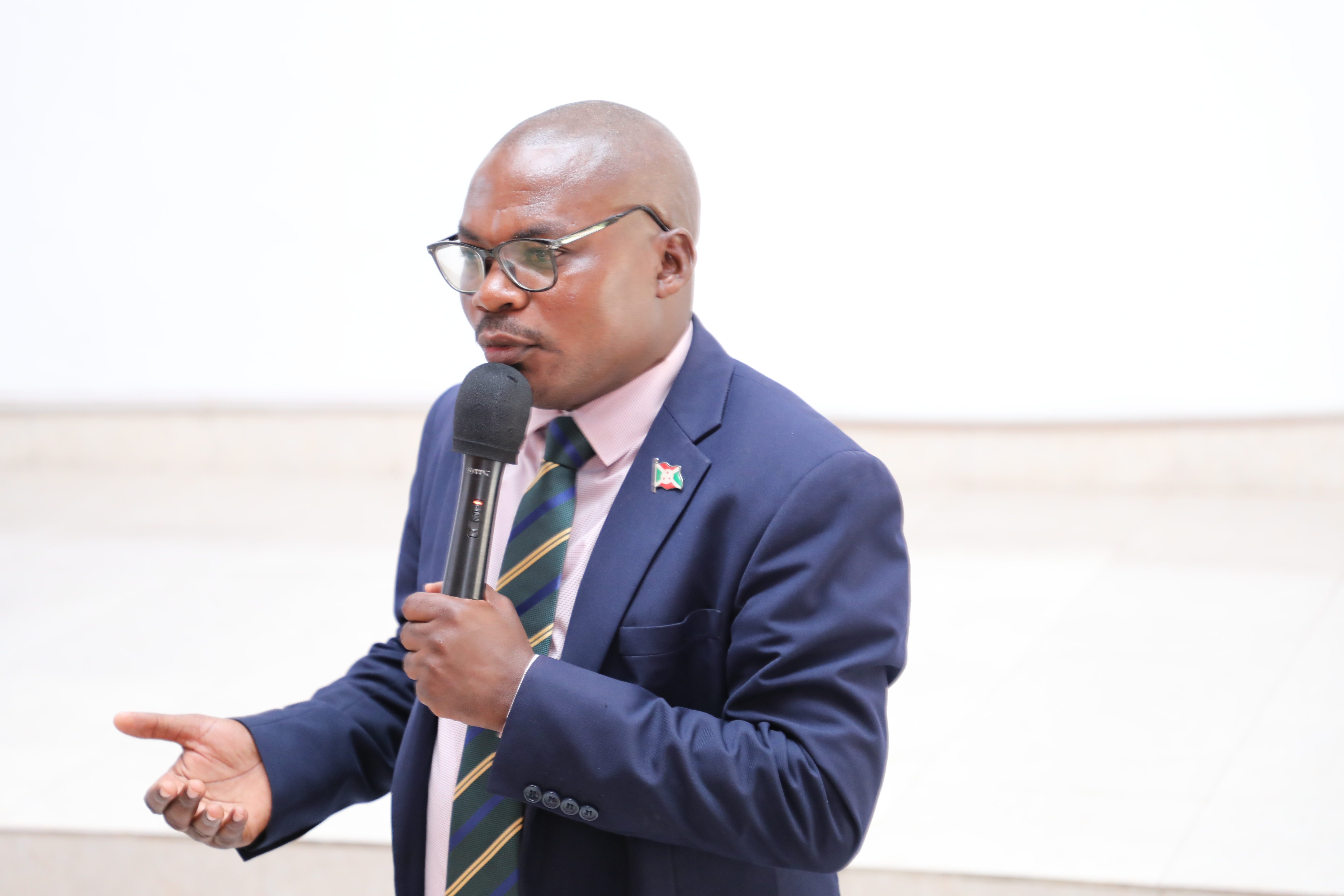
Photo enseignant

Docteur. Dionise ARAKAZA

Université : Université du Burundi
Faculté : Faculté des Sciences Politiques et Jurdiques(FSPJ)
Centre de recherche : CREDSR


Pr. Dionise ARAKAZA est un enseignant à l'Université du Burundi à la Faculté des Sciences Politiques et juridiques ; Département des Relations Internationales et Diplomatie. Pr. Dionise enseigne dans cette Université depuis 2019. Les principaux domaines de sa recherche académique sont liés aux Relations Internationales avec un accent sur la Diplomatie, les Organisations Internationales, les Organisations Non Gouvernementales Internationales (ONGs), la Négociation et la Médiation, la Sécurité, la Consolidation de la Paix et la Résolution Pacifique des Conflits. Pr. Dionise est titulaire d'un diplome de doctorat obtenu en collaboration de l'Université du Burundi et de l'Université Aoyama Gakuin du Japon. Pr Dionise a également fait le programme de Master en Sécurité, Maintien de la Paix et Diplomatie de Loughborough University London en Angleterre et celui de Master en Administration Publique et Développement de Peking University en Chine. Il avait suivi un programme de Licence à l'Université du Burundi. Sur le plan professionnel, Pr. Dionise a travaillé au sein du Ministère des Affaires Etrangères et du Développement du Burundi respectivement en tant que Conseiller, Point Focal National Civil de la Force en Attente de l’Afrique de l’Est et Premier Conseiller de la Mission Permanente de la République du Burundi auprès des Nations Unies à New York. En outre, Pr. Dionise a également travaillé comme Directeur Général de l’Ecole Nationale d’Administration du Burundi. Il publie beaucoup les résultats des oeuvres académiques.

📘 SYLLABUS DE DIPLOMATIE ET NEGOCIATION
📅 Publié le 2025-03-15 20:59:30
📄 The conflict between the Democratic Republic of Congo and the March 23 Movement (M23) is arguably one of the oldest insecurity threats in the Great Lakes region. Built on the previous unrest and ethnic confrontation, M23 emerged in 2012 as a rebel group from the former Congolese rebels dissatisfied with the government's inaction in implementing previous agreements. While several efforts have been made to end the war, it has continued to be encouraged by outside players for control over the mineral wealth endowment of the DRC. The war has led to massive dislocation, massive loss of property wealth, and a pressing humanitarian crisis, and any elements of these that are built have been reversed by continuous violence. The value of this study can be highlighted in an attempt to explain why this war has not ended despite several efforts by diplomats. In the case of the Confederacy, the major foreign allies and their function to maintain the war were the following. The paper also assesses the lack of intervention by the mediator organizations of the regional organization, African Union, and United Nations. The report also calculates the social and financial loss and damages that have resulted from war and conflicts, including refugee crises and loss of properties and resources. It finally offered suggestions for long-term peace with enhanced policing measures, smart sanctions, an interdependent economy, and a good governance program. The best remedy to these problems lies in determining lasting peace and stability and preventing future aggression.
📅 Publié le 2025-09-22 22:59:26
📄 The United Nations (UN) is the leading inter-governmental organization that still holds great power over issues of global governance, diplomacy, and international cooperation. The UN was created in 1945 and its main goal is to maintain international peace and security, and promote human rights and Socio-economic development. Thereupon, through the decades, the UN has addressed challenges and has adapted to the emergence of new threats to international peace and security, such as climate change, terrorism, pandemics, and all phenomena related to sustainable development. Nevertheless, despite its advantages in delivering diplomacy and humanitarian aid, the UN has been constantly criticized for inefficiency, bureaucracy, and disproportionate power to global leadership in keeping with the Security Council permanent members interests. UN is in need of restructuring to straighten its goals with its activities since the world of 1945 was very different from the world in the 21st century. Many of the structures and processes of the UN reflect a bygone era change that have happened in the last 65 years. Nicola-Ann Hardwick explains that reform of the United Nations is a much-debated subject constantly on the UN agenda as a necessary waiting in order to strengthen the UN’s effectiveness as a multilateral organization, bring more transparency to the institution and enhance its credibility. He also mentions that the main focus is on the reform of the Security Council (SC), as this is the most powerful UN institution with the most potential for bringing change. The present study aims to provide a critical performance-based assessment of the UN’s organizational structure, governance processes, and efficiency in managing global crises. Furthermore, the UN’s benefits and drawbacks, its structural reform needs for boosting governance efficiency and relevance to world challenges in the 21st century, will be evaluated. With reference to recent literature and empirical materials, this article provides a comprehensive review of the UN’s important role in contemporary international relations, assessing its impact on member states and identifying potential measures for continued success and effectiveness.
📅 Publié le 2025-09-22 22:30:04
📄 The United States of America (USA) held four presidential elections between 2012 and 2024, facing multiple political changes while maintaining secure democratic systems. Voting behavior and electoral management tools determine how elections take place. Every election term had new obstacles and improvements to preserve a fair system as Americans changed what they wanted their Democracy to do. President Barack Obama won a second term in 2012 after making a recovery and healthcare expansion his major campaign issues. During the 2016 presidential elections, Donald Trump became president because he appealed to populism and criticized the political system. The US public cast votes in record numbers during 2020, even with COVID- 19 present, which earned Joe Biden victory and brought back a need to unite Americans behind crucial public health initiatives. The 2024 election showed how deep political divisions in America changed the way candidates ran their campaigns, as Donald Trump won the election against Kamala Harris. Democrats and Republicans are two major political parties in the United States which compete for each election run. This analysis used qualitative research methods to assess the US presidential elections during twelve years (2012- 2024) by reviewing reports, academic studies, and case studies and considering the US reports of offices in charge of communication and press. The study also used comparative investigation techniques to observe the process of each election using results approved by the guaranteed agencies. The results have shown how political parties manage campaigns along with the ruling party's strengths and limitations to help other countries uphold democratic standards during votes.
📅 Publié le 2025-09-22 22:09:43
📞 Téléphone : +25779330193
✉️ Email : dionise.arakaza@ub.edu.bi